Your recap is written for you now. The six things that actually go wrong in a daily meeting were never about the notes — and every one of them is still here.
Your daily call is doing something useful. It is just not the thing you scheduled it for.
Almost every operations team has one. The daily call, the stand-up, the morning huddle, the shift handover. Ask the people in it whether it helps and you usually get a shrug. Here is what is actually happening in those fifteen minutes.
Something has genuinely changed about these meetings in the last two years. Teams and Zoom now write the summary, pull out the action items, and can push them straight into a task list. Nobody has to take notes any more.
That is a real change. It has also landed entirely on the wrong problem.
Here is how we know. Between 2010 and 2018, three academics sat in on 102 daily team meetings, recorded and transcribed a sample of them, and counted what the time was actually spent on. They interviewed 60 of the people attending, across 15 teams in five countries, and published it in IEEE Software.
Every one of those meetings happened before Teams recaps, before mass remote working, before a single AI summary tool existed. Read what they found and see how much of it you still recognise.
Proportion of words spoken, averaged across the transcribed meetings. Stray, Moe and Sjøberg, IEEE Software, 2020. Full source note at the foot of this issue.
Two things jump out.
The first is that the three questions this meeting exists to ask take up only about a third of it. Yesterday, today, and anything in the way. Everything else is other business that has quietly moved in.
The second is what moved in. The largest single use of time is people working through problems together — and by the rulebook, that is not what the meeting is for. The original guidance says raise the obstacle, take the discussion offline.
The part everyone valued most is the part that was never meant to be there.
Asked what they actually got out of the meeting, people named problem-solving more than anything else. Even short exchanges. A minute of two people realising they were about to duplicate the same fix.
Meanwhile the thing people said they valued least — the round of what everyone did yesterday — took more time than any other single question.
That is the whole issue in one sentence. Most daily meetings protect the low-value part by convention and let the high-value part happen by accident.
These are observations, not opinions. See how many describe your call — then look at what any of them have to do with note-taking.
The reason is not anyone's fault. Nobody knows exactly what the rest of the team needs to hear, so they read out the lot. Every queue touched, every exception cleared, every ticket closed, just in case. It showed up in team after team: people include everything they worked on regardless of whether it was relevant to anyone else. The result is a handover that matters to one person and nobody else in the room. The finding was blunt. Talking about what was already done almost never started a useful conversation.
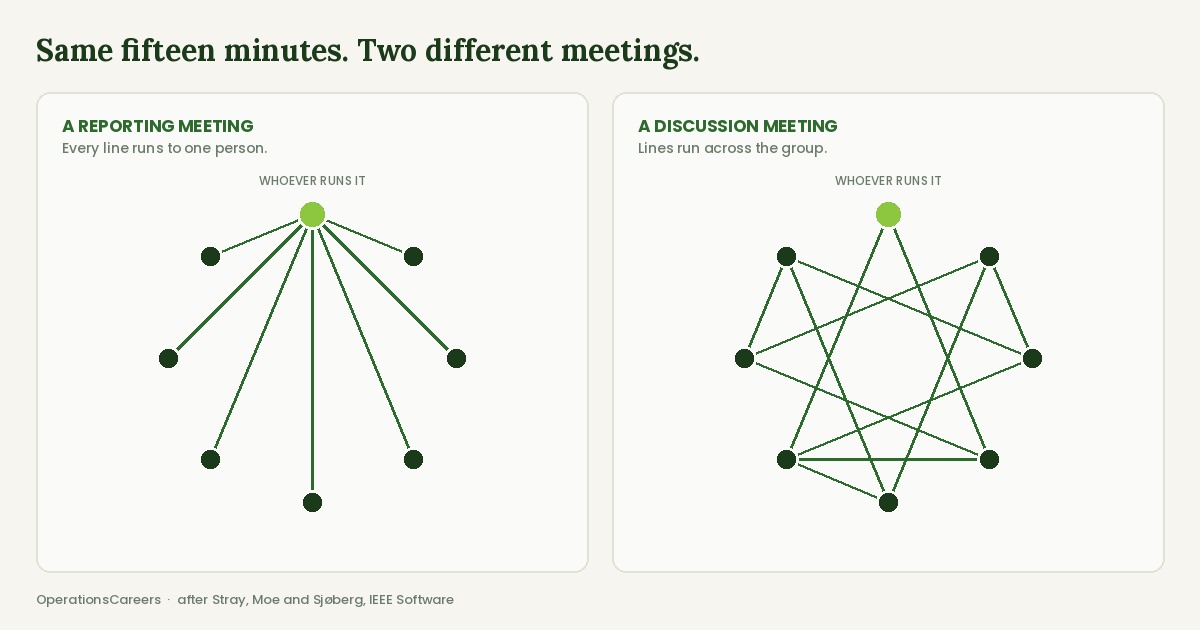
This is the one that decides whether the meeting works. Someone sat in and drew a map of who spoke to whom. In one, every line ran to the person chairing and back. In the other, the lines ran across the group — planning talking to the floor, the floor talking to despatch, without routing through the chair. Same fifteen minutes. Completely different meeting. One team member described their version as feeling like an oral exam every day. Another team told the researchers their best daily meeting happened on a day the person who normally ran it was absent.
Not deliberately. If you have a personal interest in one piece of work, you ask that person more questions. They get five minutes. The person after them gets ninety seconds, because now the meeting is running long. The researchers observed exactly this: people who spoke early got the time they wanted, people who spoke last were cut short. Every day, it is usually the same people.
There is a point where a daily meeting simply cannot function. Satisfaction with the meeting drops sharply once a team goes past twelve people. That is arithmetic, not attitude. Fifteen minutes across fifteen people is sixty seconds each, and most of what is said will not apply to most of the room. And the bigger the team, the more reliably the meeting turned into reporting.
Junior team members generally liked these meetings. They hear what is going on, and the problems they raise are the kind that can be solved in two minutes. Senior people usually already know what is going on. Their problems are too big to solve in a stand-up. A control that keeps failing at quarter end, a supplier who has missed three weeks running, a system that falls over at three in the morning — none of that gets fixed in ninety seconds, and on work like that there may be little visible progress for days. They are also in more meetings than anyone else already. They will keep attending. They will stop contributing.
It sounds like the obvious time. In practice, someone is always late, so it starts at ten past and runs long for everyone who turned up when they were asked to. The bigger cost is invisible. People deliberately avoided starting anything demanding beforehand and filled the time with work that did not need concentration. Nobody opens the exception queue or starts a reconciliation at nine if they are being pulled into a call at half nine. So the hour before gets spent on filler, and a fifteen-minute meeting quietly consumes most of the morning.
Go back over those six. Not one of them is a problem with the record.
Nobody in those meetings was struggling because the notes were bad. They were struggling because the wrong things were being said, to the wrong person, at the wrong time of day, in a group too big to hear them. Perfect minutes would not have touched a single one.
And perfect minutes are exactly what we have now been given.

There is even a new version of the old problem in it. The recap exists. The actions are written down and assigned. And tomorrow the same team will spend the same stretch of the call verbally repeating what the summary already says, to people who could have read it.
One fair challenge before you take any of this to your own team. Those meetings were watched mostly in rooms, at a time when the whole team turning up in person was still normal. If your daily call is eight muted rectangles, some of it lands differently. Which is its own answer, and it is further down this page.
We want to know what operations teams are actually doing, not what the tools promise. Results go into a later issue, and as far as we know nobody else has this picture.
One vote per browser. No sign-in, nothing stored about you beyond the count.
These were not written at a desk. A set of recommendations went out to real teams, who tried them, and someone went back to see what happened. That is where the first four below come from. The fifth is ours, and we explain where we part company with them. The sixth is a diagnostic that costs nothing.
This is the big one, and it feels wrong until you try it. Status belongs somewhere people can read it — a board, a tracker, the meeting summary. Use the meeting for the two questions that actually start a conversation: what is coming today, and what is in the way — the overnight volumes, the backlog that built, the thing that will bite at four o'clock. After nearly a decade of watching teams try it, not one had gone back to the yesterday question.
If the same person chairs every day, and that person is the team's manager, the meeting drifts back into a report. That is not a criticism of the manager. People naturally direct their update at whoever holds the meeting, and if that person also writes their appraisal, the update becomes an account of themselves.
Rotate it weekly. Everyone takes a turn, including your quietest team member — especially your quietest team member. Three things happen. The manager gets to listen instead of chair, which is a different and more useful seat. The team stops depending on one person for the meeting to happen at all, so it still runs when you are on leave. And people who have never run anything get a low-risk fifteen minutes of running something, which is the cheapest development you will ever provide.
This is the recommendation teams adopt least often, because managers assume chairing is their job. It is also the one with the widest effect.
A meeting at half nine does not cost your team fifteen minutes. It costs them the first hour, because nobody opens anything hard when they are about to be interrupted.
The fix is to attach it to a break that already exists rather than dropping it into good working time. For office-based teams, just before lunch works. It merges two interruptions into one instead of creating a second. People turn up on time because they are hungry, and finish on time for the same reason. Discussions that need another five minutes carry on the way to the canteen. Of every change tested on real teams, this was the one they took up most readily.
For shift-based operations the principle holds even though lunch may not. Attach it to a boundary that is already there: the end of a shift, the start of a handover, a scheduled break. Anywhere the work has already stopped. The test is simple — does your meeting sit inside a block of focused work, or at the edge of one?
A small finding worth more than it looks. Teams whose meetings used video rather than audio alone had noticeably more discussion and less reporting. One person explained why: when you can see whether people are listening, you talk to them instead of at them. Worth knowing that plenty of the teams observed were already spread across sites, so this is not a finding that stopped applying when everyone went home. If your daily call is eight muted black rectangles, that is not a culture problem. It is a design problem, and it has a fix.
Here is where we part company with the source. It offers two options for teams where the meeting is not working: meet less often, or split the group. For operations, we think only the second one travels, and it is worth saying why.
Software teams often work on separate pieces for days at a time. Operations rarely does. Volumes move overnight, queues build, exceptions appear, a system fails at three in the morning, and today's plan depends on what happened yesterday evening. Where work is that connected, daily contact is not ceremony. It is the job.
So the question is not whether to meet daily. It is who genuinely needs to be there daily. Most oversized daily calls are two or three real meetings that have been merged for convenience. The people whose work actually touches each other should meet every day. The wider group, who need to know things rather than coordinate on them, need a weekly session and access to the board.
If you are running a call with twenty people because that is who is on the invite, splitting it will do more for you than anything else on this list.
This is the one we expect disagreement on, and we would like to hear it. If you run a daily call that works with a large group, reply and tell us how.
The best diagnostic in the research costs nothing. Ask someone from another team to sit in on your call and draw a line every time one person speaks to another. At the end, look at the picture. If every line runs to you, you are chairing a report. Ten minutes, no tool, and it will tell you more about your meeting than any survey.
Do not attempt all six. Teams that change everything at once cannot tell which change did the work.
Neither of these is about stand-ups. Both are about the thing that decides whether yours works: how a group actually talks to itself. Video content can be audited free on both; assessments and the certificate sit behind the paid tier. Content and pricing change, so check before you enrol.
Nothing here argues for cancelling the meeting. Fifteen minutes a day with the people you depend on is cheap, and the research is clear that when it works it is one of the most useful quarter hours in the week.
The argument is narrower than that. The meeting is already doing something valuable — people solving problems together in short bursts — and most teams treat that as the bit that runs over rather than the bit that matters. Meanwhile the round of updates, which nobody rates, is protected because it is on the agenda. No amount of automatic minute-taking will change which of those two you protect. That decision is still yours.
You do not need permission or a budget to test that. You need two weeks and one change.
Keep Sharing… Keep Learning...
Sandeep
The OperationsCareers Team
OperationsCareers is building a focused publication for professionals working across operations, transformation, process improvement, PMO, reporting and workflow optimisation.
If you are hiring operational talent, promoting a relevant tool or course, or looking to reach a practical professional audience, we are open to selective sponsorship and featured opportunities.
The views expressed in this newsletter are based on personal professional experience and observation. They do not constitute professional, legal, financial or career advice.