We asked whether AI has actually changed your day-to-day work. Six in ten of you said no. Employers, meanwhile, have already started putting AI skills in the job description. That mismatch is this issue.
Your employer's expectations changed before your workflow did.
You told us what has actually changed in your team. For most of you, not much. But the job adverts have already moved on, and that is worth understanding before it turns up in your next appraisal.
Six in ten of you say AI has not changed the actual work. Not the pilots. Not the roadmap. The work.
We ran a poll in the LinkedIn group last week. 44 people answered. People running the shift, not people presenting slides about it.
44 responses, OperationsCareers LinkedIn group, July–August 2026. Small sample, and people who care about AI are the ones most likely to answer a poll about AI. We will say that every time we run one. This is a signal from this community, not a market survey.
You can read that two ways.
The cheerful version: 71% have AI somewhere in the building, and only 11% have none at all. Three years ago that would have been news.
The one that stuck with us: 61% have pilots, meetings and plans, and a job that looks much the same as it did last year. Someone bought a licence. Someone ran a kickoff. Monday morning is unchanged.
Now put that next to what employers are saying.
Last week ZipRecruiter published its 2026 AI Employer Report. They asked over a thousand US hiring managers and recruiters what AI has changed about the way they hire. Three answers matter if you are building an operations career.
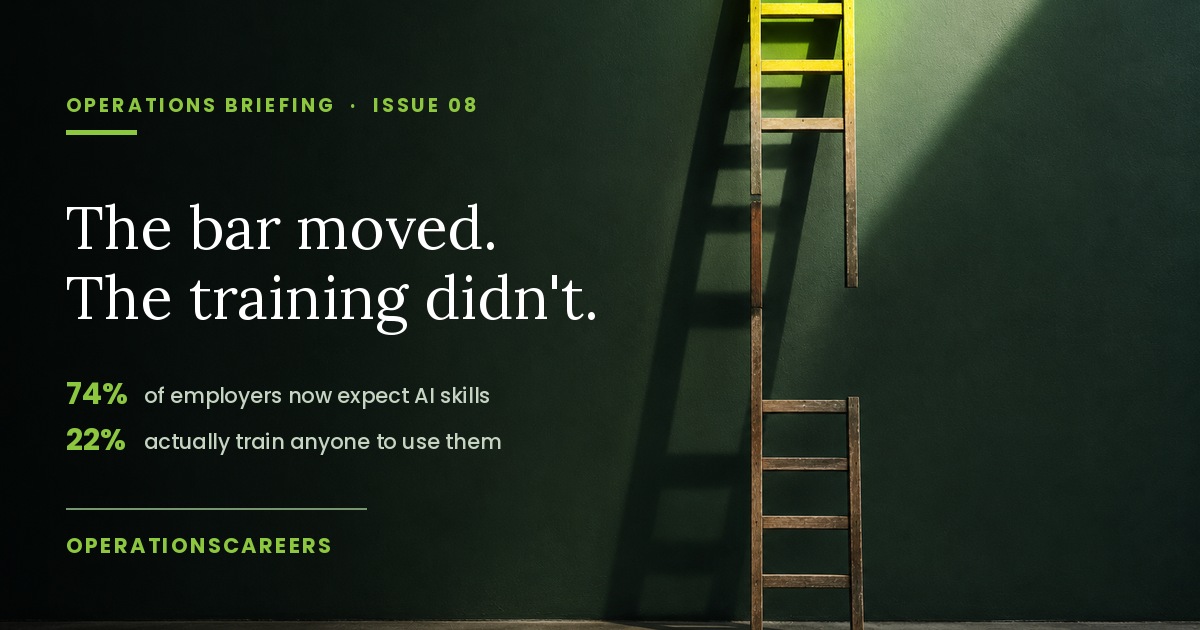
74% now count AI skills as a strong advantage or a flat requirement for at least some roles. 13% require them for every role in the company. This is not a prediction about 2030. It is in the adverts going up this month.
57% have raised what they expect people to produce. More work, better, faster, on the assumption AI is already helping. Look at what that assumption runs into: 61% of you say the work has not changed.
Only 22% run mandatory AI training for everyone. Another 23% offer it to a few departments. That leaves more than half of people with an optional link, or nothing.
One finding is easy to miss and worth holding onto. The same employers said critical thinking (65%), judgement (59%) and creativity (58%) matter more in hiring than they did a year ago. The human skills went up too. Not away.
Being straight about the data: this is a US online panel, about a thousand employers, all self-reported. Good for direction, not for precision. Same goes for our 44.
The bar moved. For most people, the ladder did not.
A gap like that does not just evaporate. It has to land somewhere, and in operations it usually lands on people. Same team, same systems, bigger number to hit.
Neither of these is technical. Both are for people who have to make calls about AI rather than build it, and both can be audited for free. Content and pricing change, so check before you enrol.
The Chicago Fed published a working paper in July that looks backwards rather than forwards, at what actually happened to jobs between 2019 and 2024. Occupations most exposed to AI grew by 4.05%. The less exposed ones shed jobs. Wages went up either way. Their own conclusion: exposure tells you a role is being reshaped, not that it is going away.
Sage asked 200 retail and wholesale supply chain operators how much AI they had actually running live. The answer was 10%. Keep that number to hand the next time a deck implies everyone else is already there.
In the same survey, 38% of employers had already moved basic data processing off entry-level staff and onto AI, and 31% had raised the experience bar for entry-level roles because of it. If you hire, this is your problem too. The routine work that used to teach people the process is disappearing, and you still need them to learn it.
Five operations roles open at the time of writing, linked directly to the employer's own application page rather than to a job board. Roles close without notice, so check before you invest time in an application.
If the expectation has gone up and nobody has offered you training, waiting for a policy is a slow plan. Go in with something concrete instead.
Employers say they want the skill. Only 22% say they train anyone in it. We want to know what that looks like from where you are sitting. Results go into the next issue.
One vote per browser. No sign-in, nothing stored about you beyond the count.
Restructuring is not nothing. The shape of the job changes, and the person who saw it coming does better than the person who did not. But it is a long way from the headlines, and the Chicago Fed numbers are a reasonable place to stand.
Here is the bit worth taking into Monday. Every organisation asking for more output without offering more capability has a problem it has not named yet. Naming it, measuring it and suggesting something workable is not a new skill you have to go and learn. It is the one you already have, pointed at a gap everyone else is quietly hoping sorts itself out.
Keep Sharing… Keep Learning...
Thanks to everyone who voted. The next poll goes out in the group this week, this time on whether your employer has actually trained you.
OperationsCareers is building a focused publication for professionals working across operations, transformation, process improvement, PMO, reporting and workflow optimisation.
If you are hiring operational talent, promoting a relevant tool or course, or looking to reach a practical professional audience, we are open to selective sponsorship and featured opportunities.
The views expressed in this newsletter are based on personal professional experience and observation. They do not constitute professional, legal, financial or career advice.